

Lesson Contents
The IPv6 PACL (Port Access Control List) is basically a regular IPv6 access-list that is applied to a switchport (L2 interface). They only work inbound.
Configuration
Let’s look at quick example. Here’s the topology we’ll use:
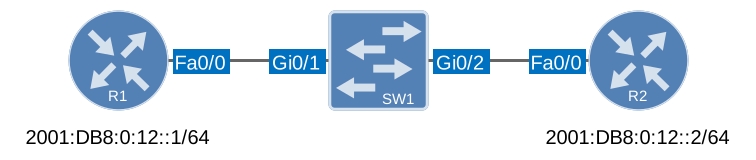
We will use R1 and R2 to generate some IPv6 traffic and on SW1 we’ll configure the PACL.
Let’s configure some IPv6 addresses on R1 and R2:
R1(config)#interface FastEthernet f0/0
R1(config-if)#ipv6 address 2001:DB8:0:12::1/64R2(config)#interface FastEthernet 0/0
R2(config-if)#ipv6 address 2001:DB8:0:12::2/64Let’s enable HTTP server so that we have something to connect to:
R2(config)#ip http serverWithout an ACL, I can connect to the telnet server (enabled by default) and the HTTP server:
R1#telnet 2001:DB8:0:12::2
Trying 2001:DB8:0:12::2 ... OpenR1#telnet 2001:DB8:0:12::2 80
Trying 2001:DB8:0:12::2, 80 ... OpenLet’s create an access-list that denies telnet traffic and permits everything else:
SW1(config)#ipv6 access-list NO_TELNET
SW1(config-ipv6-acl)#deny tcp any host 2001:DB8:0:12::2 eq 23
SW1(config-ipv6-acl)#permit ipv6 any any
We can see the access-list we created with the show ipv6 access-list command:
SW1#show ipv6 access-list
IPv6 access list NO_TELNET
    deny tcp any host 2001:DB8:0:12::2  eq telnet sequence 10
permit ipv6 any any sequence 20Let’s activate the access-list on the GigabitEthernet 0/1 interface that connects to R1:
SW1(config)#interface GigabitEthernet 0/1
SW1(config-if)#ipv6 traffic-filter NO_TELNET in
Now, from R1 I’ll try to connect to the telnet and HTTP server on R2:
R1#telnet 2001:DB8:0:12::2
Trying 2001:DB8:0:12::2 ...
% Connection timed out; remote host not respondingR1#telnet 2001:DB8:0:12::2 80
Trying 2001:DB8:0:12::2, 80 ... OpenAs you can see, telnet traffic is no longer permitted.
Unfortunately, hits don’t show in the access-list:
SW1#show ipv6 access-list
IPv6 access list NO_TELNET
    deny tcp any host 2001:DB8:0:12::2  eq telnet sequence 10
    permit ipv6 any any sequence 20
There is the debug ipv6 access-list command but it doesn’t seem to work for PACLs, it only works when you apply an access-list to a routed (L3) interface.
Hello, everyone.
Happy to be the first one to make a post here :smiley:
I am studying about ACLs for my ENCOR exam and the following piece of information is mentioned in my book:
PACLs have a few restrictions that vary from platform to platform. The following are some
of the most common restrictions:
PACLs only support filtering incoming traffic on an interface (no outbound filtering support)
... Continue reading in our forumPACLs cannot filter Layer 2 control packets, such as CDP, VTP, DTP, PAgP, UDLD, and
> STP.
PACLs are supported only in hardware.
PACLs do not support ACLs to filter
Hello David
Indeed some of these restrictions do seem somewhat arbitrary, however there are explanations for each.
Concerning no outbound filtering support: This has to do with the internal design of a switch, and the https://notes.networklessons.c...ated-circuit-asic that are used for hardware processing. On a Layer 2 interface, traffic is typically already in the “switching path” once it reaches egress. Applying a PACL on outbound traffic would require the ASIC to re-analyze packets after the forwarding decision has been made, resulting in less
... Continue reading in our forum